Motorcycle-Style E-Bikes in the Police Crosshairs

On November 26, Ontario’s Minister of Transportation, Prabmeet Singh Sarkaria, announced tougher rules for motorcycle-style e-bikes. If you ride in Ontario (to Niagara, Ottawa or farther), this matters to you, even if you will never sit on one of these machines.
What changes on May 1, 2027
Watch the date. Most news stories only say “May 1.” The Ontario government’s own page says 2027. So we still have the winter and the spring ahead of us (and the riding season doesn’t restart before then anyway!).
To count as an e-bike in Ontario, the machine needs a bicycle-style frame, fully operable pedals and a motor assist that tops out at 32 km/h. The official page also lists a motor of no more than 500 watts and a maximum weight of 120 kg. Anything above those limits will be treated as a motor vehicle: driver’s licence, registration and insurance, and no bike lanes.
Fines can reach $2,500, and the vehicle can be impounded. According to the province, removing the pedals turns an e-bike into a motor vehicle. Officials also say they will use the coming months to educate riders before enforcement starts.
One thing to note: neither the news story we started from nor the official page says which licence class will be required, so I won’t guess.
Why it matters to us
Toronto Police Supt. Mandeep Mann sums up the problem well: a vehicle is not a legal e-bike simply because it is available for sale. He cites hundreds of reported collisions involving e-bikes.
What worries me is the mix of traffic. These machines look like motorcycles, but they can be ridden by people with no training at all. They are quiet, they can accelerate fast, and you meet them in the city as well as on secondary roads. A few simple habits when riding in Ontario:
- don’t assume a “cyclist” is moving slowly;
- keep a good gap at lights and intersections;
- check your blind spot twice instead of once before changing lanes, especially in town.
Municipal rules can come on top of the province’s. The government advises checking them.
What about Quebec?
At home, the electric-assist bicycle has limits similar to Ontario’s. According to the Quebec government’s website, the motor must be 500 watts or less, and the assist must cut off at 32 km/h or less. You must be 18 or older (14 to 17 year olds can ride one if they hold a licence that allows them to drive a moped), and a helmet is mandatory.
For a machine that goes beyond those limits, I couldn’t find a SAAQ page that explains it plainly. If you are thinking of buying one, or you keep meeting them on your route, ask the SAAQ directly before riding. (Being for sale in Quebec doesn’t make it legal on the road!)
Ride safe!
Before you head out on a ride in Ontario or anywhere else, take the time to plan your trip properly.
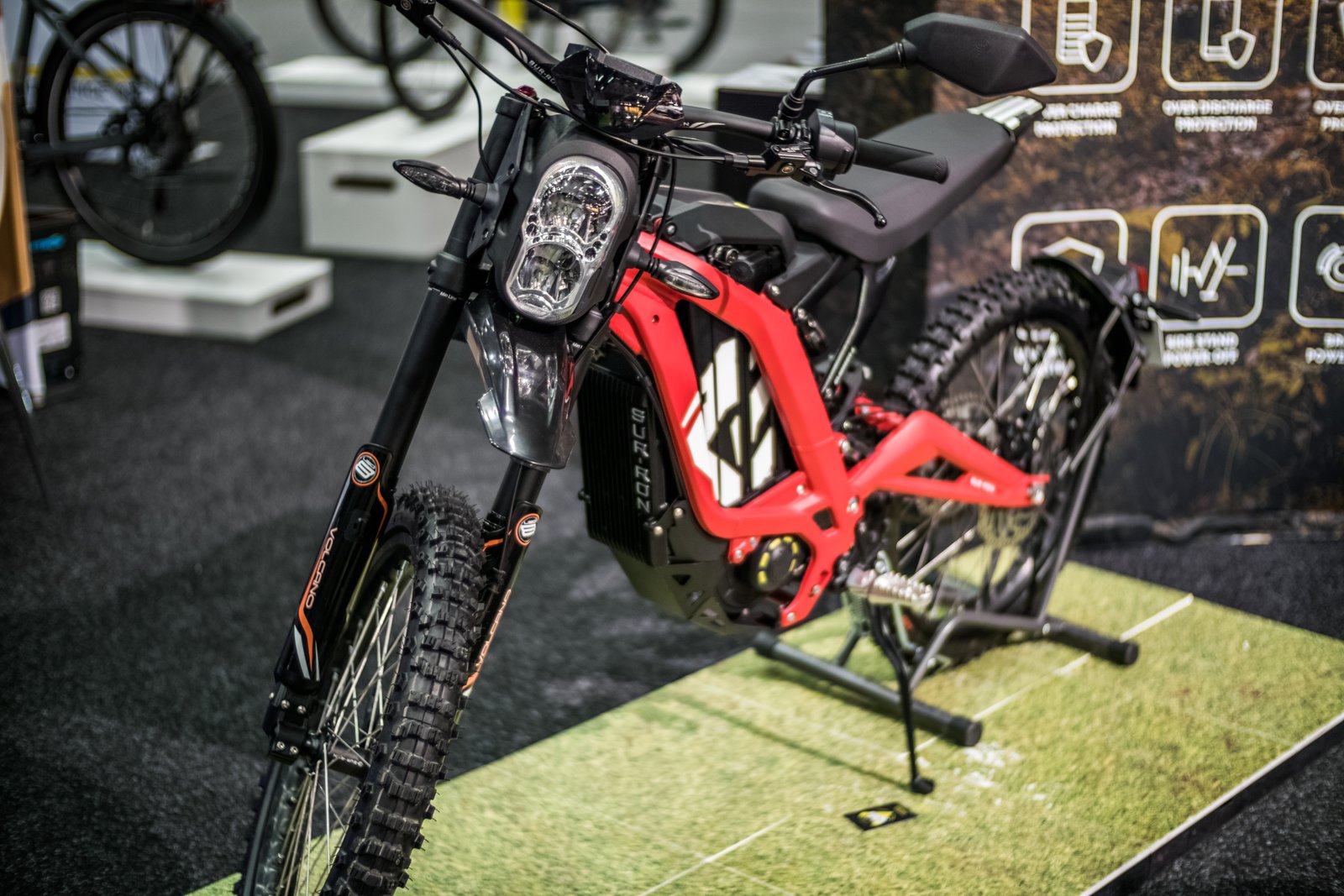
Photo
A Sur-Ron, an electric motorcycle-style model, on display at a trade show. Illustration only: it shows the kind of machine targeted by the rules, not an event or an Ontario road. Photo: Ivan Radic, CC BY 2.0.
Sources
- Government of Ontario, “Riding an e-bike” (changes taking effect May 1, 2027, limits, fines)
- Ontario Newsroom, backgrounder on strengthening e-bike regulations
- Barrie360 / The Canadian Press, announcement of November 26, 2026
- Frequency News, “Ontario tightens e-bike rules as Durham reports rise in collisions”
- Government of Quebec, electric-assist bicycles (in French)