The motorcycle rear brake: useful, or just decoration?

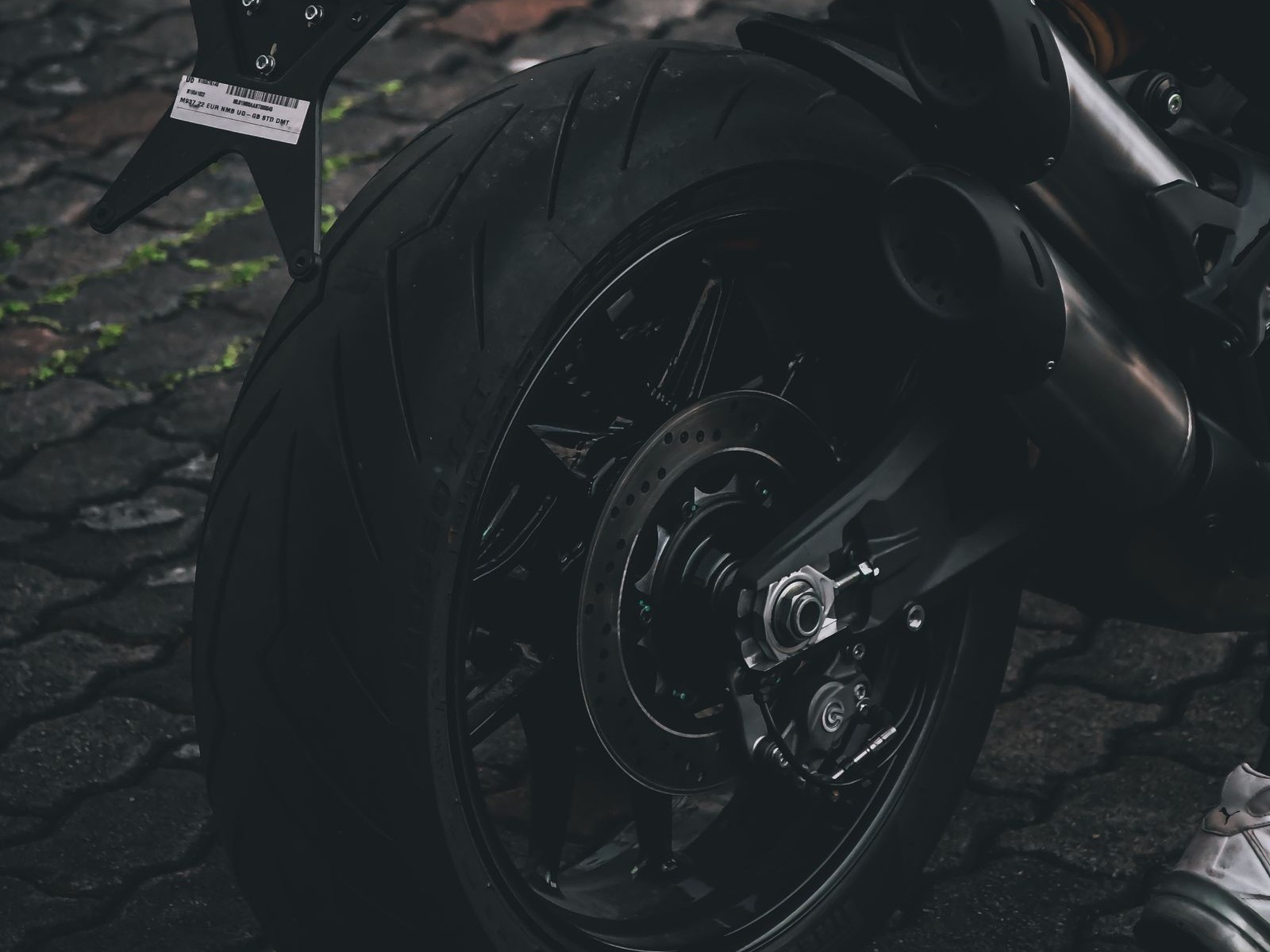
Ask riders about the rear brake and you’ll hear two stories. Sportbike riders say it’s almost decorative: it locks up, it does nothing, leave it alone. Cruiser riders say the opposite: the front brake is scary, so they mostly use the rear. Both have a point, and both miss the bigger picture. The rear brake is a precision tool. If you never use it, you’re riding with half your brakes!
The real myth
The biggest myth isn’t that the rear brake is useless. It’s the idea that braking is only about slowing down. Your bike has two brakes, and each one has a job. Use both, and you’ll ride smoother, more precisely and more safely.
Key points
- The rear brake isn’t just for slowing down: it stabilizes the bike.
- At low speed, it saves you from constantly working the throttle.
- How much it helps depends on the bike: more on a cruiser than on a sportbike.
Sportbike or cruiser: not the same rear brake
It all comes down to weight transfer. When you brake, weight moves forward: the front tire loads up and the rear gets light. On a sportbike (short wheelbase, aggressive geometry), hard braking can nearly lift the rear wheel. There, the rear brake adds very little and locks easily.
On a cruiser, it’s the reverse. Long wheelbase, low centre of gravity, weight toward the back: the rear tire keeps its load and the rear brake really helps you stop. That doesn’t mean ignoring the front. Harley-Davidson’s Reflex linked brakes, on its touring models, split braking force between both wheels. And they unlink below 32 to 40 km/h, precisely so they don’t get in the way of slow manoeuvres.
Nick Ienatsch, an instructor at Yamaha Champions Riding School, sums it up well: there’s no magic formula. A cruiser can use much more rear brake than a light sportbike, but even on a sportbike, you shouldn’t ignore it. It all depends on wheelbase, load, grip and how much you’re already asking of the front.
More than a speed scrubber
The rear brake also shapes how the suspension behaves. A touch of rear brake just before you squeeze the front, and the rear of the bike squats: the fork dives less and the stop is more stable. In an emergency, that can be the difference between a controlled stop and a swerve. The goal isn’t to replace the front brake. It’s to have two tools instead of one, and to make them work together.
Your best friend at low speed
A tight U-turn, a parking lot, rush-hour traffic on the 401: a bit of throttle, clutch in the friction zone, rear brake dragging lightly. The bike settles, your speed gets precise, and you stop fiddling with the throttle. It won’t hold the bike up by itself (your eyes, steering and balance still matter), but once all three controls work together, the manoeuvres that used to stress you out get easy.
What about corners?
You were taught to finish braking before the turn. For a beginner, that’s the right advice. But advanced schools (Yamaha Champions Riding School, California Superbike School, Total Control) teach trail braking: light, progressive braking carried into the turn to manage speed and tighten your line. It takes feel. A sudden stab of brake mid-lean can overwhelm the available grip, and ABS is a safety net, not a substitute for technique. That’s something you learn with an instructor. Across Canada, many motorcycle schools offer advanced or refresher courses.
Three drills for the start of the season
When the bike comes out in the spring, before your first trip, spend an hour in an empty parking lot:
- Straight-line stops: brake a little harder on each pass to feel how your bike responds.
- Figure-eights and tight U-turns between two cones: steady throttle, rear brake dragging.
- Firmer stops: a little rear first, then the front, progressively, to feel the bike settle before you brake hard.
Frequently asked questions
Should you use the rear brake on a motorcycle?
Yes. It stabilizes the bike when braking, helps a lot at low speed and can add stopping power, especially on a cruiser or touring bike.
Why does the rear brake lock up so easily?
Because braking shifts weight forward. The rear tire gets lighter, especially on a sportbike, and loses grip.
What is trail braking?
Light, progressive braking carried into a corner. It’s an advanced technique best learned in a course.
Ride safe!
Photos
Main photo: a motorcycle’s rear wheel, showing the rear brake disc and caliper. Photo: Akshay Bineesh, Pexels.
Sources
- TopSpeed, “The Rear Brake Myths That Are Holding Motorcycle Riders Back” (November 16, 2026).
- Harley-Davidson service documentation on Reflex linked brakes; RideApart, “How Does Harley’s Reflex Defensive Rider System Work?”.