Mandatory hi-vis vest for motorcyclists: should Quebec follow France?
In France, since January 1, 2016, every motorcyclist has had to carry a high-visibility vest on them or on the bike. Here in Quebec, there’s no such rule. So should the SAAQ follow France’s lead? It’s a divisive question, and I want to know where you stand. But before we start the debate, let’s look at what the law actually says on both sides of the Atlantic.
At a glance
- France: a high-visibility vest must be on board since 2016, worn only after an emergency stop. €11 fine if it’s missing, €135 if you don’t put it on.
- Quebec: no requirement. The SAAQ recommends light or fluorescent clothing with reflective strips and a brightly coloured helmet.
- Cost of a vest: a few dollars, and it folds up under the seat.
What the law says in France
Careful: you don’t have to wear the vest while riding. Under a decree dated May 7, 2015, in force since January 1, 2016, the rider must carry it on them or in a storage space on the bike. They only put it on if they have to leave the bike stopped on the road or shoulder after an emergency stop. The rule covers motorcycles, scooters, mopeds, three-wheelers and quads. Passengers aren’t covered.
- No vest on board: €11 (about $17 CAD).
- Vest not worn after an emergency stop: €135 (about $213 CAD), up to €750.
- No demerit points.
The vest must carry the CE marking (EN ISO 20471 standard). And in France, approved gloves have been mandatory since November 20, 2016, passengers included. That’s a long way from what we’re used to!
Interesting fact: at the time, France’s main riders’ association, the FFMC, opposed the vest, saying it was useless. Even in France, it never had everyone’s support.
What the law says in Quebec
Here, the SAAQ requires:
- a helmet that meets a recognized standard (DOT, ECE 22, Snell, CAN-3-D230 and a few others);
- a visor or protective glasses when the speed limit is over 50 km/h (a windshield doesn’t count);
- reflectors on the motorcycle.
The rest are recommendations: light, bright or fluorescent clothing with reflective strips, a white, yellow or orange helmet, auxiliary lights. In other words, with a DOT helmet and sunglasses, you’re legal from one end of Quebec to the other.
What about Quebec’s move-over law (the “corridor de sécurité”), in force since 2012? It requires drivers to slow down and move over for emergency vehicles, tow trucks and some patrol vehicles. A rider broken down on the shoulder of Highway 20 isn’t covered by that rule. They’re counting on being seen.
The case for
A rider stopped on the side of the road at night or in the rain is barely visible. And in Quebec, the riding season ends in October and November, when it’s dark by 5 p.m. Picture a flat tire in the Laurentides wildlife reserve after dark, with trucks going by at 100 km/h. A fluorescent vest costs a few dollars and takes up no room. It can make the difference between being seen and being hit.
The case against
The vest only helps when you’re stopped. It doesn’t protect you while riding, and that’s when the danger is greatest. Many riders also don’t like being told to carry one more thing, especially since the SAAQ already recommends bright colours. And a law means tickets. Quebec riders already feel they pay their share through registration fees. Our roads, our climate and our habits aren’t the same as France’s.
My take
I don’t think we need one more law. But a vest costs less than lunch at a roadside diner, and it folds into a pannier. Law or no law, if you ride late in the season or far from town, pack one. The day you need it, you’ll be glad you have it.
What about you? Should the SAAQ make the vest mandatory like in France, or is the recommendation enough? For, against, somewhere in between? Tell me in the comments, and why!
Ride safe!
Photos
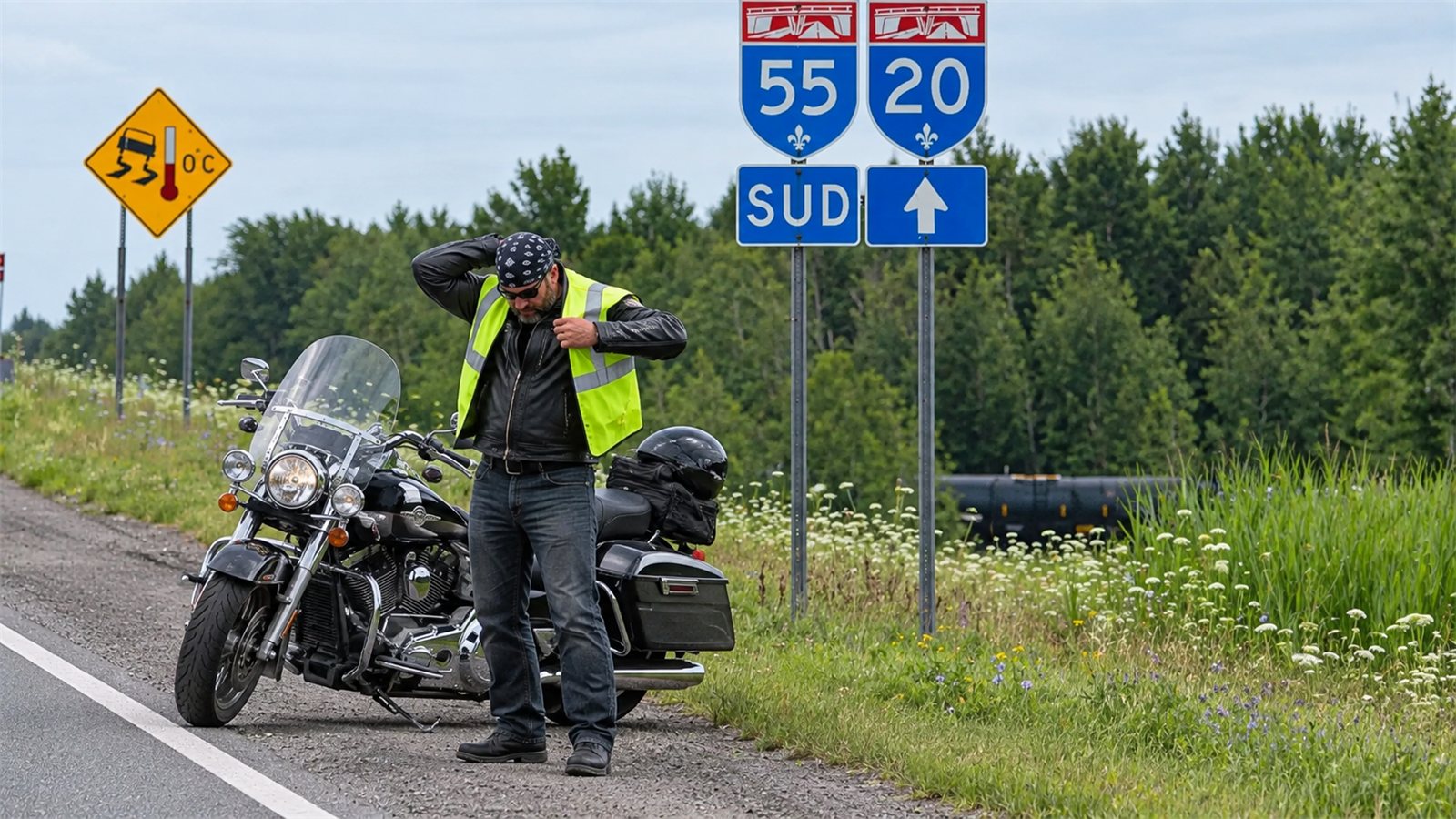
Main illustration: a rider puts on a yellow vest on the shoulder near the Highway 20 and 55 interchange. This isn’t a real photo: it’s an AI-generated image made for Voyage Moto Québec.
Sources
- SAAQ, “En moto : ce que dit la loi” (French).
- SAAQ, “Casque et vêtements de protection” (French).
- SAAQ, “When Riding a Motorcycle, Make Sure You Are Visible”.
- CAA-Québec, “Corridor de sécurité” (French).
- Dordogne prefecture, Decree No. 2015-514 of May 7, 2015 (French).
- Troc-Motard, “Gilet jaune moto : obligation, port, norme et amende” (fines and standard, French).
- LégiPermis, mandatory gloves from November 20, 2016 (French).
- Moto Planète, “Gilet jaune : pour la FFMC, il ne sert à rien” (French).